New Year good-luck traditions around the world
Twelve grapes, first-footing, temple bells and wishes at midnight: the stories behind New Year customs, what they share and how to enjoy them without fear.

Five minutes to midnight, a small piece of paper and a wish that suddenly seems urgent. In Russia, someone is writing that wish before the clock strikes. In Madrid, someone has twelve grapes ready. In Tokyo, a temple bell sounds. In Scotland, a household waits for its first visitor of the year.
The customs look different, yet their themes are familiar: clear away the old, welcome someone in, share food and give the future a hopeful beginning.
New Year traditions do not control chance. They can help people mark a transition, express an intention and feel connected. That is a different kind of value from making a prediction come true.
Russian New Year customs
A wish at midnight
Making a wish as the Kremlin chimes sound is a widespread Russian custom. A 2024 VCIOM survey found that 59% of respondents did so, although participation and belief were not the same thing. Some enjoyed the gesture without expecting magic.
The familiar practice of burning a written wish and putting the ashes into a drink has uncertain origins. It should not automatically be described as an ancient Slavic ritual. You can keep the wish and leave out the fire and ashes: writing a sentence is enough to make the intention visible.
A generous table and a fresh start
Common advice includes clearing debts, wearing something new, keeping money in a pocket, cleaning the house and setting a generous table. Another saying claims that the way you meet the year determines how you will spend it.
These are customs, not obligations. A quiet evening, an unfinished task or a mortgage does not condemn the coming year. A celebration should not become an exhausting test of whether you have done everything correctly.
Why Russia has an Old New Year
Peter I moved the beginning of the year to 1 January for 1700 and encouraged decorations using evergreen branches. He did not introduce the Gregorian calendar. Russia retained the Julian calendar until 1918; the difference between the calendars later placed the old 1 January on 14 January. This is the background to the Old New Year.
The festive tree has its own history. After restrictions on Christmas celebrations in the Soviet period, it returned in the 1930s as a secular New Year tree. Modern celebrations combine several historical layers rather than one unchanged ancient tradition.
St Basil's Eve and sowing songs
The eve of the old-calendar New Year was associated with abundant food, visits, songs and wishes for prosperity. On the following morning, boys or men might scatter grain in a house while singing blessings for the harvest. The first visitor, the food and the grain all gave the coming year a symbolic beginning.
Welcoming good fortune over the threshold
Scotland: first-footing
At Hogmanay, the first person to enter after midnight traditionally brings good fortune. Coal, whisky and shortbread are among the familiar gifts, representing warmth and hospitality. Cleaning the house and preparing the hearth also formed part of the transition.
Local calendars and customs vary. Burghead's Burning of the Clavie takes place in January rather than at the ordinary midnight celebration, showing how older dates can survive alongside newer ones.
The Carpathians and Balkans: the first visitor
The polaznik, or first festive visitor, appears in several regional traditions. The visitor might be a man, a boy or, in some places, an animal brought over the threshold. The custom connected a particular arrival with hopes for crops, livestock and family wellbeing. It should not be reduced to one rule shared by every community.
China: cleaning, red decorations and fu
Before the Spring Festival, households clean and prepare for family gatherings. Red decorations, gifts in red envelopes and respect for elders and ancestors are central themes. Some customs discourage sweeping at the beginning of the year for fear of sweeping away good fortune.
The character fu, meaning good fortune, is sometimes displayed upside down because of a wordplay connecting “upside down” with “arrive.” Legends about the creature Nian help explain the associations of red, noise and protection. Family reunion matters at least as much as the lucky symbols.
Iran: Nowruz and renewing the house
Nowruz falls around the spring equinox. Khaneh tekani, often translated as shaking the house, names the thorough cleaning beforehand. Chaharshanbe Suri features fire, while the haft-sin table gathers symbolic objects.
These practices have long and layered histories. A modern arrangement should not be assumed to have existed in precisely the same form for thousands of years.
Foods that carry a wish
- Spain: Twelve grapes with the midnight chimes; The twelve months ahead.
- Italy: Lentils, often with pork; Prosperity, with lentils resembling coins.
- Southern United States: Black-eyed peas and rice, including Hoppin' John; Good fortune and abundance.
- Japan: Toshikoshi soba on the final evening; Longevity and the passage between years.
- Greece: A pomegranate and vasilopita with a hidden coin; Abundance and a fortunate recipient.
- Philippines: Round fruits and polka dots; Coins and prosperity.
The often-repeated story that Spanish grape growers invented the custom in 1909 is too neat: newspaper references predate that year. A memorable origin story is not always the earliest evidence.
Round foods can resemble coins and long noodles can suggest a long life. Similar symbols do not require every tradition to share one historical source.
What colours mean at New Year
Red clothing or underwear is associated with luck in parts of Italy, while yellow is linked with prosperity in some Latin American customs. White clothing at Brazilian celebrations often expresses peace. Red is prominent in Chinese festivities, and round patterns are familiar in the Philippines.
These are regional practices with variations. Claims that a particular colour has one exact ancient origin deserve more caution than a list of fashionable holiday tips usually gives them.
Fire, water and noise
Brazil: waves and offerings
On the Brazilian coast, New Year's white clothing, flowers and encounters with the sea connect with Afro-Brazilian religious traditions, including devotion to Iemanja. Jumping seven waves has become part of many celebrations. A large public festival can combine religious practice, family custom and tourism without making them identical.
Ecuador: saying farewell to the old year
Anos Viejos are effigies burned at the year's end, sometimes representing politicians or familiar public characters. They offer a visible goodbye to the past, with room for humour and satire.
Denmark and Colombia: making the transition physical
Stories of Danish celebrations include broken crockery and jumping into the new year from a chair. In Colombia, carrying an empty suitcase around the neighbourhood expresses a wish for travel. These gestures make an abstract hope into an action that can be shared and remembered.
Thailand: Songkran
Thailand's April New Year is famous for water festivities, but its meaning also includes washing Buddha images, respectfully pouring water over elders' hands and asking for blessings. The respectful practices should not disappear behind the image of a giant water fight.
Japan: 108 bell strokes
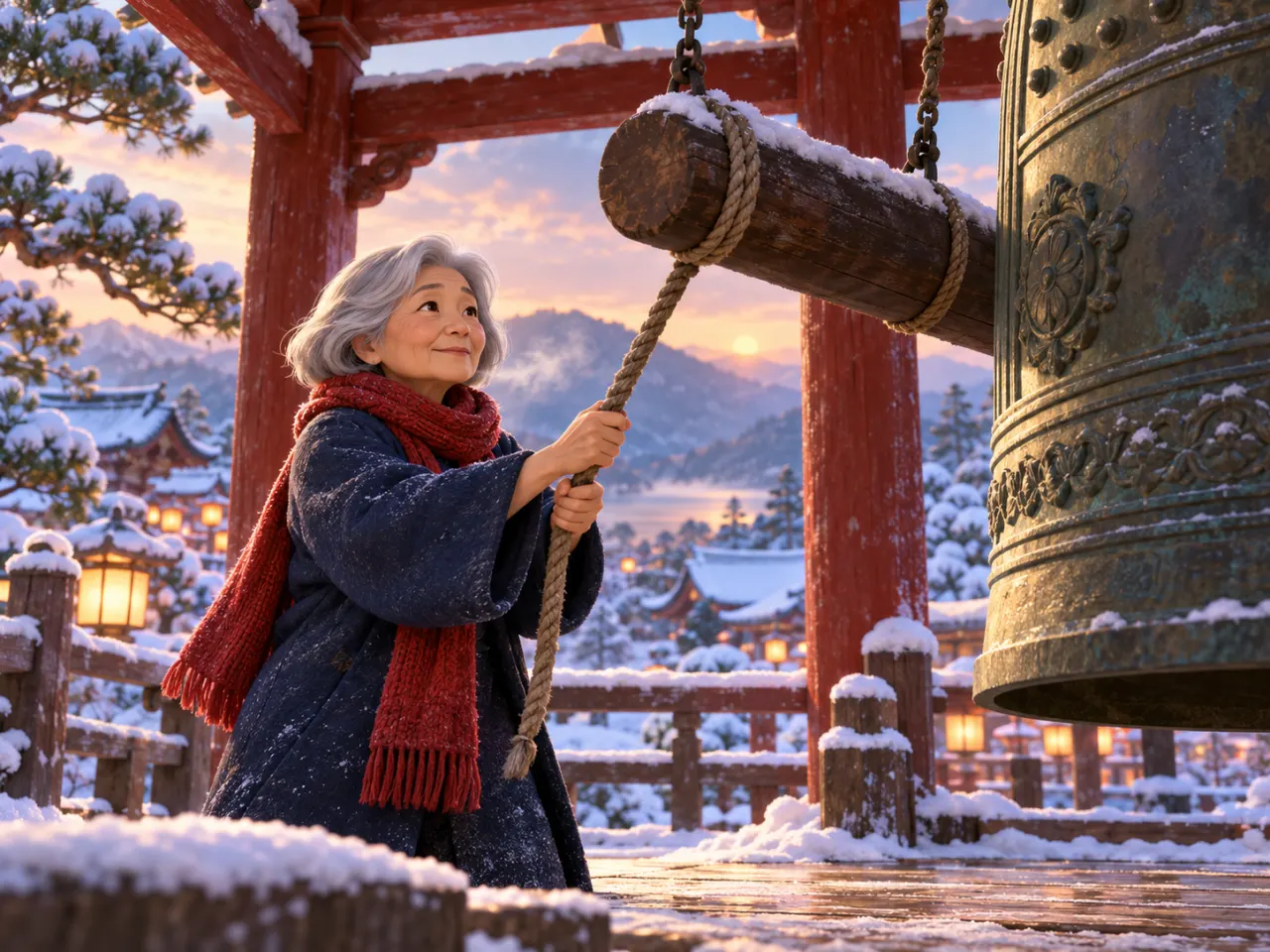
Buddhist temples ring bells 108 times, associated with releasing human attachments and obscurations. The first shrine or temple visit, hatsumode, and the first sunrise, hatsuhinode, also give the beginning of the year a deliberate shape.
Dreams, shapes and the year ahead
Hatsuyume is the first dream of the new year in Japanese tradition. Mount Fuji, a hawk and an aubergine are considered a particularly fortunate sequence. Different explanations exist for these images; there is no single certain origin story.
In German-speaking regions, people interpreted shapes made by pouring melted lead into water. Wax offers a modern alternative without treating an old material as essential. The pleasure can lie in inventing a story together rather than obtaining a reliable forecast.
Why customs in different countries resemble one another
Similarity and contact
Anthropologist James Frazer described ideas of sympathetic magic: something that resembles a desired result is used to invite it, or good fortune is imagined to pass through contact. Coins, grain, round fruit and a fortunate first visitor fit these patterns as interpretations of ritual logic. They do not prove magical causation.
A threshold between one period and another
Arnold van Gennep described rites of passage through separation, a transitional period and incorporation into a new state. Cleaning before midnight, counting down together and welcoming the first morning form an easily recognised version of that movement.
Giving uncertainty a manageable shape
When the future is uncertain, a concrete action can offer structure. It is easier to tidy a room or share a meal than to guarantee a prosperous year. Shared customs also let a family agree on how to mark the moment.
That does not mean every religious observance is a method of attracting luck. Rosh Hashanah, for example, includes hopes for a sweet year alongside prayer, reflection and responsibility. A religious act, a folk omen and a personal promise can look similar while meaning different things.
What research can and cannot say
The fresh-start effect, described by Hengchen Dai, Katherine Milkman and Jason Riis, concerns the motivational role of temporal landmarks. A new year, birthday or new week can help people feel that a new chapter is possible.
Research on New Year's resolutions has also distinguished approaching a desired behaviour from merely trying to stop an unwanted one. A concrete intention such as taking a short walk is easier to act on than the general demand to become a different person.
Research on ritual itself is mixed. Some studies suggest effects on anxiety or social connection, but well-known papers have also been retracted. It would be misleading to use a single impressive experiment as proof that any invented ritual improves performance or controls events.

A countdown, song or shared meal can still matter without that proof. Its value may be a memory, a conversation or the first action attached to a goal.
Choose a custom that leaves you freer
- Pick something you enjoy rather than a rule you fear breaking.
- Give it a meaning you can explain: gratitude, a fresh start or time with people you love.
- Connect a wish with one small action you can take in January.
- Leave room for ordinary life. A difficult New Year's Eve does not decide the next twelve months.
Common questions
Do I have to stay awake until midnight?
No. Resting, working or spending the evening quietly does not bring bad luck.
Which tradition is the most effective?
None has been shown to control fortune. The most useful one is a manageable gesture that supports connection or a concrete intention.
Can I take part without believing?
Yes. Many people enjoy a custom as play, family continuity or a way to mark time.
Does a forgotten wish lose its chance?
No ritual can establish that. If the wish matters, write down a practical next step and return to it when you can.
The year does not need a perfect opening scene. A generous welcome, a quiet moment or one realistic promise is already a beginning. Explore the daily Luck cards, or read about good-luck customs beyond New Year.
Read next

Dreams about teeth and hair falling out: beyond the bad omen
What research suggests about jaw sensations and teeth dreams, where frightening folk meanings come from, and how to explore appearance, change and vulnerability.

Dreams about ex-partners, cheating and weddings
How memory and relationship concerns enter dreams, why a cheating dream is not evidence, and how to keep its mood from deciding your next conversation.